

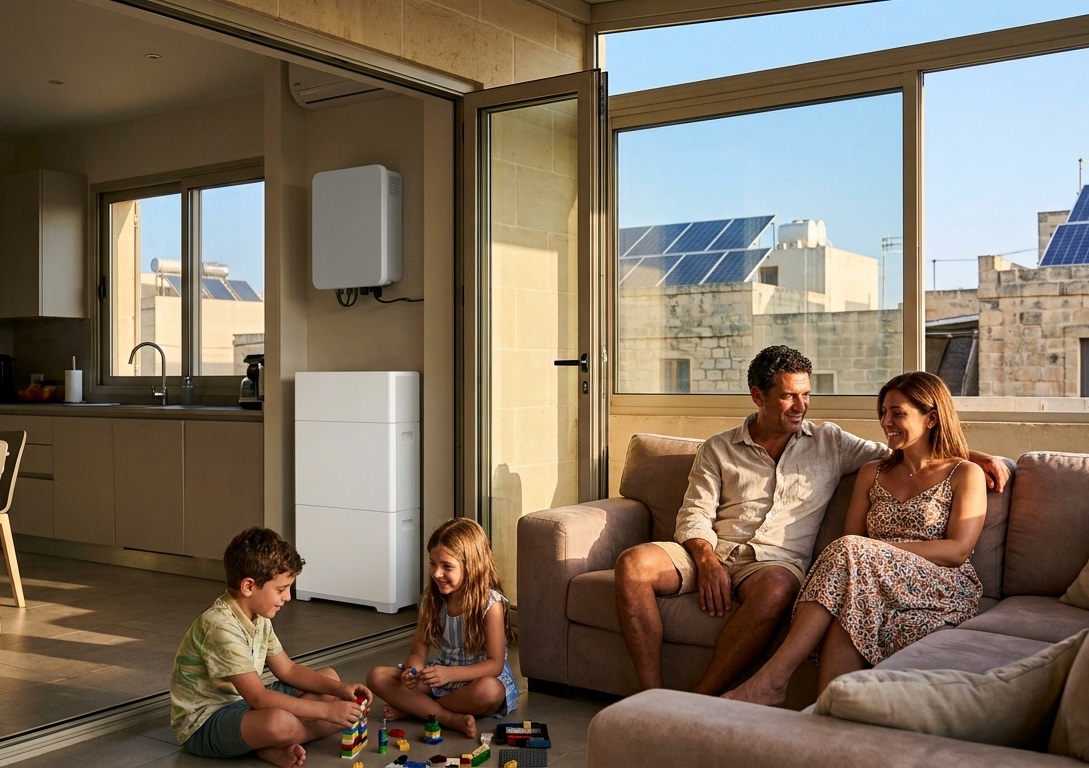
Most conversations about solar start with money, payback periods, kilowatt-hours, and grant percentages. And the numbers do matter. But ask people who’ve actually made the switch what they value most, and the answer is rarely a spreadsheet figure. It’s a feeling: control.
This is the part that doesn’t fit neatly into a calculator, and it might be the most important part of all.
The quiet anxiety of depending on the grid
Whether you’ve named it or not, depending entirely on the grid carries a low hum of anxiety.
You don’t control the price of your electricity, a distant subsidy decision does. You don’t control whether the power stays on during a July heatwave, an ageing cable does. You open the bill not quite knowing what you’ll find, and you run the AC with one eye on the cost.
For Maltese households, this isn’t abstract. The island imports much of its electricity from Italy through the Sicily interconnector, which ties local power to a volatile foreign market. A government subsidy is what keeps the bill manageable, for now. And several recent summers have brought real power cuts during the worst of the heat. Dependence, in other words, comes with genuine uncertainty attached.
What changes when you produce your own power
The shift, when households describe it, is less about numbers and more about how it feels day to day:
You stop flinching at the bill. When a large part of your electricity comes from your own roof, the bill stops being a monthly verdict you brace for. You already know roughly what it’ll say, because you can see your panels producing.
You stop rationing comfort. Running the air conditioning through a heatwave feels different when it’s powered by the sun rather than premium-rate grid units. The guilt evaporates. You just stay cool.
The blackout stops being a threat. With a battery, a summer power cut becomes something that happens to other houses on the street. Your lights stay on, your fridge keeps humming, your kids keep their fans. You find out there was an outage from the neighbourhood chat, not from your own dark living room.
You stop worrying about what the government decides. If the subsidy changes, it changes for everyone exposed to the grid. You’ve quietly stepped out of that line of fire.
Your cost of power is largely fixed, for decades.
That collection of small reliefs adds up to something bigger than any single one of them: the sense that your home is yours, that its basic functioning doesn’t hinge on decisions and infrastructure you have no say over.
It’s a form of security, not just savings
There’s a useful way to think about this. A solar-and-battery system isn’t only an investment that pays back. It’s a kind of insurance, except instead of paying premiums for a payout you hope never to need, you’re paying once for a benefit you enjoy every single day: lower bills and protection against the things that make grid dependence stressful.
You’re buying certainty in a market built on volatility. And certainty, for most people, is worth a great deal.
How far you take it is up to you
Energy independence isn’t all-or-nothing. It’s a spectrum, and you choose where on it you want to sit:
- Solar panels alone cover most of your daytime needs and cut your bill meaningfully.
- Add a battery and you extend that into the evenings and gain blackout protection.
- Add efficient systems like a heat pump, and more of your home runs on your own clean power.
Each step buys back a little more control. Many Maltese homeowners start with panels and grow from there as they feel the difference, see our guide to solar storage for how the pieces build into a self-sufficient home.
The bottom line
The savings are real, and they’re a perfectly good reason to go solar. But the people who love their decision most rarely talk about payback periods. They talk about the calm of knowing their home runs on power they produce, priced at a rate they control, available even when the grid isn’t.
That peace of mind is hard to put a number on. It’s also, for many, the whole point.
Start with our complete guide to solar energy in Malta.
Ready to take back control of your home’s energy? Request a free, no-pressure assessment from ISD.