

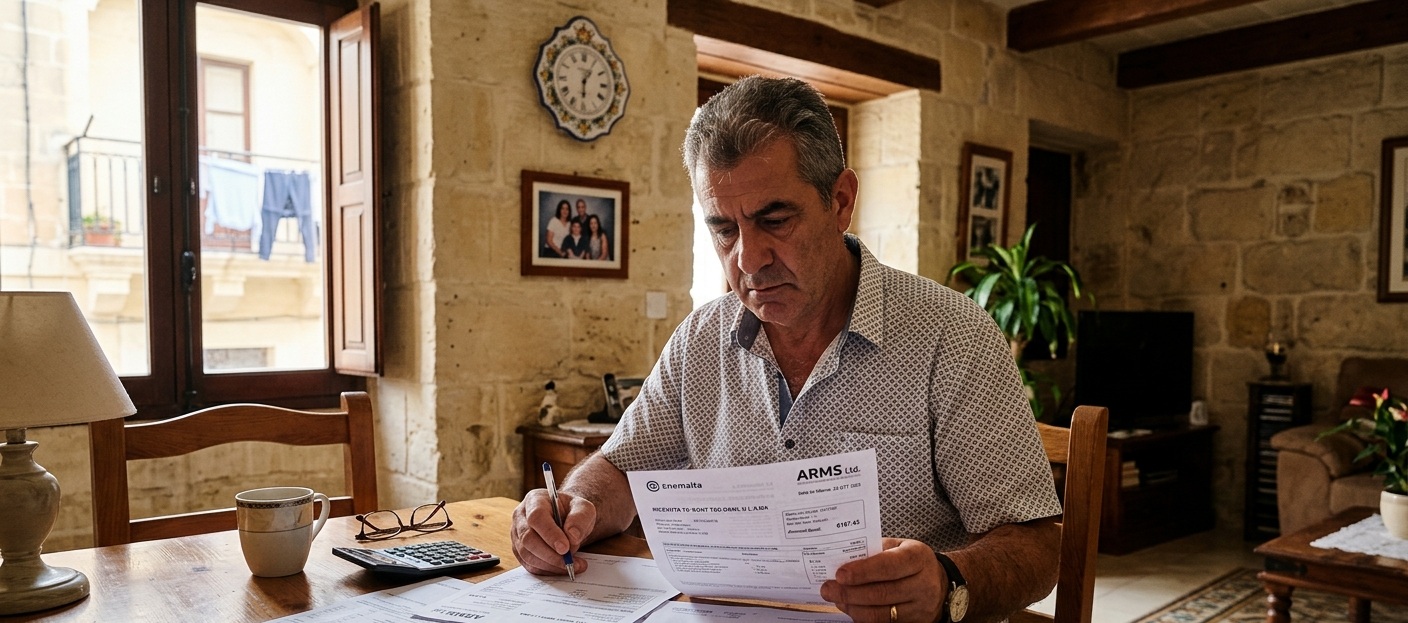
Malta has some of the lowest electricity rates in the EU on paper, so why does your bill keep climbing? The honest answer is that the headline rate isn’t the rate most households actually pay. Malta’s billing system has quirks that quietly push people into higher charges, and most people never realise it.
Here are seven reasons your bill may be higher than it should be, several of which you can fix this week, and one that fixes the problem permanently.
1. You’re climbing into the higher tariff bands
This is the big one almost nobody understands. Malta charges residential electricity in cumulative bands across the year. The more you consume over the year, the higher the rate you pay on the units above each threshold. The bands work roughly like this:
- Band 1 (first 2,000 kWh): around €0.105 per unit
- Band 2 (next ~4,000 kWh): around €0.13
- Band 3 (up to ~10,000 kWh): around €0.16
- Band 4 (up to ~20,000 kWh): around €0.34
- Band 5 (above that): around €0.60
Look at that jump. The moment your annual usage climbs past Band 3, your marginal rate roughly doubles to €0.34, and a heavy household can hit €0.60 per unit, nearly six times the lowest band. The “cheap” Maltese electricity everyone talks about only applies to the first few thousand units.
2. You’re being billed bimonthly, which accelerates the climb
Because bills are issued every couple of months rather than annually, your cheaper-band allowances get chopped into shorter periods. A heavy two-month stretch, say, a brutal summer with constant AC, can tip you into a higher band for that period even if your annual total would have stayed lower. The result: you start paying premium rates sooner than the yearly quota alone would suggest.
3. You’re on the “Domestic” tariff instead of “Residential”
This is the single most common and most fixable mistake. In Malta, a Residential account (with people registered as living there) gets cheaper rates and eco-reduction benefits. A Domestic account, used for properties with no residents registered, is charged at higher rates.
Plenty of households, especially renters, discover they’ve been sitting on the more expensive Domestic tariff for years. If your bill says “Domestic,” there’s a strong chance you’re overpaying. Check it.
4. You don’t have the right number of people registered
On a Residential account, the cheaper consumption bands get larger for each person registered at the address. A two-person household incorrectly registered as one person hits the expensive bands faster and can lose part of its eco-reduction discount. Confirming the correct number of registered residents with ARMS is a free fix that can save real money.
5. Your water heating is quietly enormous
A conventional electric geyser is one of the heaviest loads in a Maltese home, often running far more than people assume. Because water heating is constant, it pushes your cumulative consumption up month after month, helping shove you into those higher bands. Switching to a heat pump water heater, which uses a fraction of the electricity and carries a government grant, removes a big chunk of that load.
6. Standby and “vampire” loads add up
Devices left on standby, old fridges, inefficient lighting, and always-on electronics draw power around the clock. Individually they’re small; collectively, across a year, they quietly inflate your cumulative consumption, and remember, every unit pushes you closer to the next band. Auditing and trimming these is low effort for a steady saving.
7. You’re exposed to a subsidy that can change
Here’s the reason behind the reasons. Malta’s rates are held down by a government subsidy, because the island imports much of its electricity from Italy via the Sicily interconnector.
That subsidy is the only thing standing between you and Italian-level prices (closer to €0.33 per unit). If it ever narrows, every one of the reasons above gets more expensive overnight.
The permanent fix
You can, and should, do the quick wins: check you’re on Residential, fix your registered persons, cut standby loads, and tackle water heating. They’ll help.
But the structural problem, climbing tariff bands and exposure to a volatile imported price, has only one permanent solution: generate your own electricity. Solar panels cover your daytime usage directly, which keeps your cumulative annual consumption down and stops you climbing into the €0.34 and €0.60 bands in the first place. Add a battery and you cover the evenings too.
It’s the difference between managing a high bill and removing the cause of it.
Frequently asked questions
Why is Maltese electricity cheap but my bill still high?
Because the cheap rate only applies to your first few thousand units a year. Beyond that, cumulative tariff bands push your rate up to €0.34 and even €0.60 per unit.
What’s the difference between Residential and Domestic tariffs in Malta?
Residential accounts (with registered residents) get cheaper rates and eco-reduction. Domestic accounts (no residents registered) pay more. Many people overpay by being on the wrong one.
How can I lower my electricity bill in Malta?
Check you’re on the Residential tariff, register the correct number of residents, cut standby loads, replace an electric geyser with a heat pump, and ultimately generate your own power with solar to avoid the higher bands entirely.
Does solar reduce which tariff band I’m in?
Yes. By generating your own daytime electricity, solar lowers the cumulative grid consumption that pushes you into the expensive €0.34 and €0.60 bands.
Want to see exactly how much solar would cut from your bill? Request a free ISD assessment.