

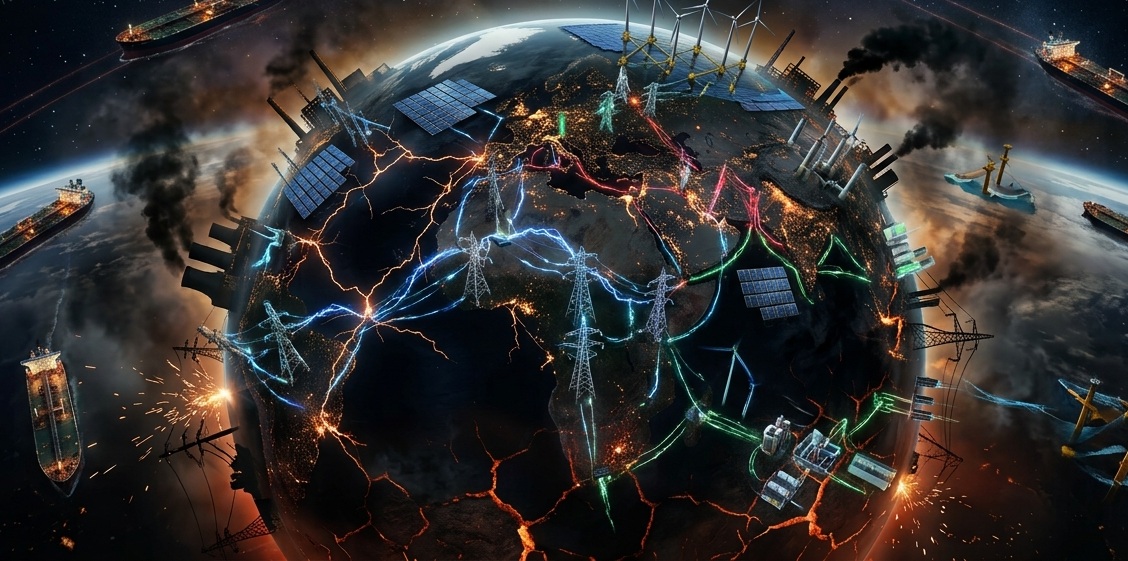
It’s easy to assume the energy crisis ended with the headlines. In 2022, gas prices in Europe went vertical, governments scrambled, and households across the continent watched their bills double. Then the panic faded from the news, and most people moved on.
The problem is that the underlying vulnerability never went away. And in 2026, it’s flaring up again. For Maltese homeowners in particular, this matters far more than most people realise, because of one fact that rarely makes the local conversation: Malta doesn’t make most of its own electricity. It imports it.
The crisis didn’t end. It just went quiet.
Through early 2026, European gas prices climbed again. A colder-than-normal winter drained storage faster than usual, and fresh geopolitical shocks in the Middle East disrupted the flow of liquefied natural gas (LNG) that Europe now depends on. By early June 2026, the European gas benchmark (TTF) was trading around €48–49 per MWh, well above the calm levels of late 2025, and Europe’s gas storage was sitting noticeably lower than the same point a year earlier.
The deeper issue is structural. Even though gas now generates only around a fifth of the EU’s electricity, it still sets the price of power across much of the continent because of how the market works. When gas spikes, electricity prices in gas-reliant countries spike with it. During the 2026 tensions, day-ahead electricity prices in countries like Italy and Germany jumped sharply.
Italy is the part that should make every Maltese homeowner sit up.
Malta’s Hidden Exposure: The Sicily Interconnector
Malta has no significant energy resources of its own. A large share of the island’s electricity arrives through the Malta–Sicily interconnector, a cable linking us to the Italian grid. That means Malta’s true cost of electricity is effectively tied to the Italian and wider European wholesale market.
When European gas prices surge, Italian electricity prices surge, and Malta’s real cost of power surges too. The only reason most Maltese households haven’t felt it is the government subsidy, which currently holds the consumer rate at around €0.13 per kWh, one of the lowest in the EU. For comparison, Italy’s household price sits closer to €0.33, and the EU average is around €0.29.
Strip away the subsidy and Malta’s real electricity cost would likely track somewhere around €0.22–€0.26 per kWh, in line with what it actually costs to import the power.
Why This Should Matter to You
Here’s the uncomfortable truth in one sentence: the subsidy is a buffer, not a guarantee.
No government can promise to absorb volatile global energy prices forever. Subsidies are a political and budgetary choice, and they are vulnerable to exactly the kind of sustained price pressure that 2026 has already shown is possible.
If that buffer ever narrows, Maltese bills move quickly toward the European level, and the gap between what you pay today and what you’d pay then is large.
That’s not a prediction of doom. It’s a risk assessment. And the sensible response to a known risk isn’t panic, it’s preparation.
What You Can Actually Do About It
The most effective hedge against energy-price volatility is to stop being fully dependent on the grid for your power. Every unit of electricity you generate yourself is a unit whose price you’ve locked in, immune to gas markets, interconnector economics, and the future of a subsidy.
That’s the real argument for home solar in Malta, and it has very little to do with being “green.” It’s about certainty. A solar system fixes a large part of your energy cost for the next 25 years. Add a battery and you extend that protection into the evenings and through grid disruptions.
In a country whose power is imported, priced off a volatile foreign market, and shielded only by a subsidy that can change, generating your own electricity is one of the few genuine forms of control a household has.
The Bottom Line
The energy crisis isn’t a closed chapter, it’s an ongoing condition of how Europe, and especially an import-dependent island like Malta, gets its power.
The homeowners who came out of 2022 best weren’t the lucky ones. They were the ones who used the warning to build their own resilience.
Want to know what producing your own power would mean for your specific home? Request a free assessment from ISD.