

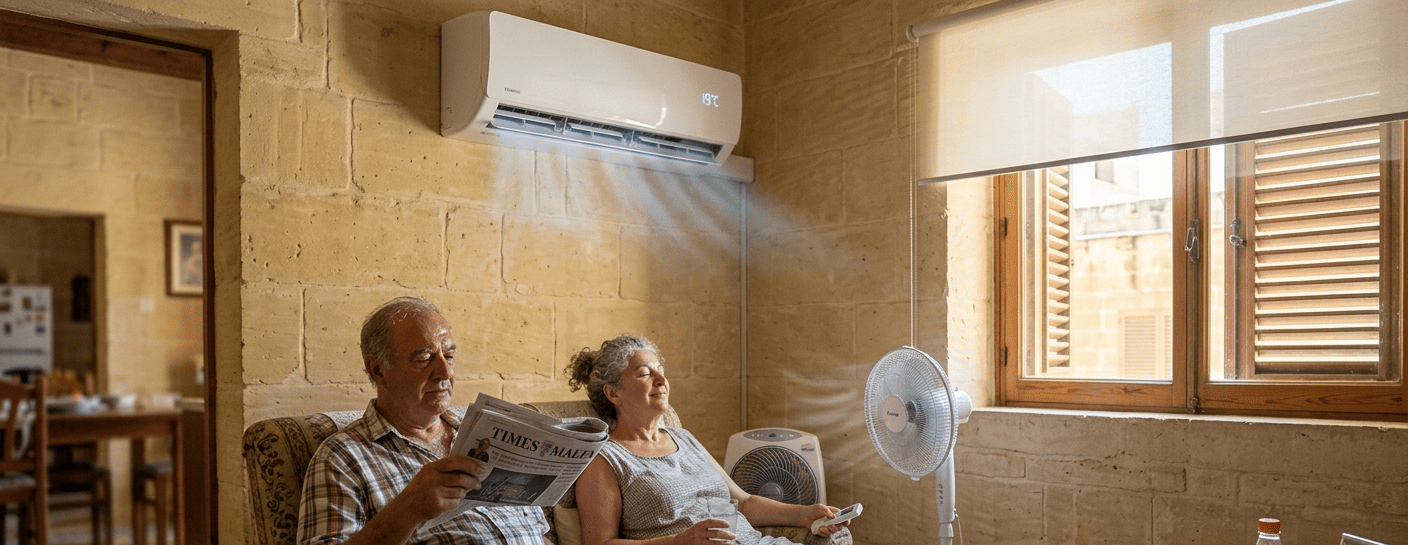
It’s a Maltese summer ritual. The heat becomes unbearable, the air conditioning runs day and night, and for a few weeks life is tolerable again. Then the bill arrives, and the comfort curdles into regret.
What most people don’t realise is that the damage doesn’t stop when summer does. Thanks to how Malta bills electricity, a heavy AC summer can keep costing you well into autumn.
Here’s why that happens, and how to break the cycle for good.
Why AC is the single biggest driver of your summer bill
Air conditioning is, by a wide margin, the heaviest electrical load in a typical Maltese home during summer. Run several units across a hot day and night, multiply that across weeks of heatwave, and the consumption is enormous. It’s no coincidence that Malta’s national electricity demand hits record peaks during exactly these periods, hundreds of thousands of AC units switching on at once.
But the size of the load is only half the story. The other half is how that load is priced.
The trap: Malta’s cumulative tariff bands
Malta charges residential electricity in cumulative annual bands. The more you use over the year, the higher the rate you pay on units above each threshold. The lowest band is around €0.105 per unit, but once your cumulative consumption climbs high enough, the rate jumps to around €0.34, and for the heaviest users, up to €0.60 per unit.
Here’s the cruel part. A summer of heavy AC use doesn’t just cost more during summer. It pushes your cumulative consumption for the year up into those higher bands, and once you’re there, you tend to stay there. So the electricity you use in September, October, even November, can be billed at the elevated rate your summer drove you into. The “shocking bill” isn’t one bill. It’s a season’s worth of inflated rates triggered by a few brutal weeks.
And because bills are issued every couple of months, a single hot billing period can tip you over a threshold faster than your annual usage alone would.
Why you can’t just “use less AC”
The usual advice, set it to 26°C, close the blinds, use it less, helps at the margins, but it doesn’t solve the problem. In a Maltese summer, cooling isn’t a luxury; for many households it’s a health necessity. Telling people to suffer through the heat to save money is both unrealistic and, during a heatwave, genuinely unsafe.
The real solution isn’t using less cooling. It’s changing where the power for that cooling comes from.
The fix: power your AC with the sun that’s causing the problem
Here’s the elegant part. Your air conditioning works hardest exactly when the sun is strongest, the middle of a hot summer day. That’s also precisely when solar panels produce the most electricity.
It’s a near-perfect match. A solar system generates peak power at the same hours your AC draws peak power, meaning your cooling can run largely on free, self-generated electricity instead of grid units billed at €0.34 or €0.60. You break the link between “cooling my home” and “climbing into the expensive bands.”
The result:
- Daytime AC runs on solar instead of premium-rate grid power.
- Your cumulative consumption stays low, keeping you out of the high bands, which protects your autumn and winter bills too.
- Add a battery and you store the day’s surplus to run the AC into the evening, when it’s still hot but the panels have stopped.
What about water heating?
While you’re at it, the second-biggest household load is usually water heating. A conventional electric geyser quietly adds to your cumulative consumption all year round.
Swapping it for a heat pump water heater, which uses a fraction of the energy and carries a government grant, removes another big contributor to band-climbing. Paired with solar, your water can be heated on your own power too.
Breaking the cycle, step by step
- Solar panels sized to cover your daytime cooling load.
- A battery to extend that power into the hot evenings and through any summer power cuts.
- A heat pump to cut the year-round water-heating load that quietly pushes your bill up.
Together, these don’t just lower your summer bill, they stop the heavy summer from poisoning the rest of your year.
Learn more about solar panels in Malta and solar batteries.
Frequently asked questions
Why is my electricity bill still high after summer in Malta?
Because Malta’s tariff is cumulative. A heavy-AC summer pushes your yearly consumption into higher-priced bands,
and you keep paying those elevated rates on later usage into autumn.
How much does air conditioning cost to run in Malta?
A lot, AC is the biggest summer load in most homes, and the units it consumes can be billed at the higher tariff bands (up to €0.34–€0.60 per unit) once your cumulative usage climbs.
Can solar panels run my air conditioning?
Yes, and it’s an ideal match: panels produce the most power at exactly the hot, sunny hours when your AC works hardest. A battery extends that into the evening.
Should I just use less air conditioning to save money?
It helps a little, but in a Maltese heatwave cooling is often a necessity. Powering your AC with solar is the realistic fix, it cuts the cost without cutting the comfort.
Tired of dreading the summer bill? Get a free solar assessment from ISD and power your cooling with the sun.